



活動訊息
-
活動時間:
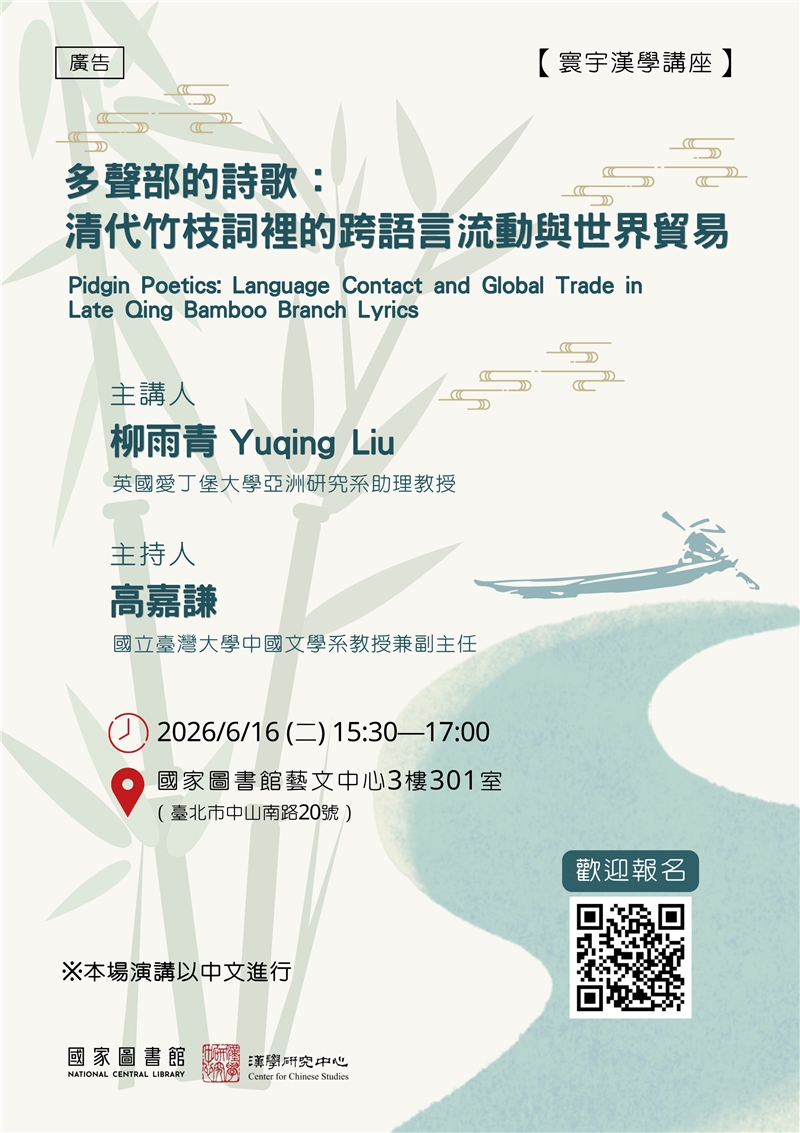
- 2026-06-16 15:30 ~ 17:00
2026寰宇漢學講座
講者:柳雨青(Yuqing Liu,英國愛丁堡大學亞洲研究系助理教授)
講題:多聲部的詩歌:清代竹枝詞裡的跨語言流動與世界貿易(Pidgin Poetics: Language Contact and Global Trade in Late Qing Bamboo Branch Lyrics)
主持人:高嘉謙(國立臺灣大學中國文學系教授兼副主任)
時間:2026年6月16日(週二)15:30-17:00
地點:國家圖書館藝文中心3樓301室(臺北市中山南路20號)
備註:本場演講以中文進行
※以上會議時間如有變動,本中心將依報名資料另行通知
演講摘要:
皮欽語大約於18世紀出現在中國珠江三角洲一帶,是一種由英語、粵語、葡萄牙語、馬來語、官話、閩南語等各種中外語言混合而成的通用語。19世紀中葉,第一次鴉片戰爭後,大批粵籍商人與勞工相繼赴滬謀生,此一語言遂隨之擴散至長江三角洲地區。我的報告將探討貿易中產生的日用詞典、民歌、以及商人、文士的詩歌創作,追溯這一貿易語言在文學中的聲音再現。我將分析這些創作如同調動漢字之語義、視覺與語音諸維度,使詩中皮欽語的表達形式構建出多層次的意義結構。皮欽語的引入因此開啟了廣闊的詮釋向度,使得各種讀法互相交織彼此並立。此外,這些詩歌多以竹枝詞的形式書寫,然而有別於傳統竹枝詞將異域語言收編馴化的書寫,這些詩歌呈現相反的聲音想象:皮欽語的介入使本土的景觀異域化,從而將貿易中心的廣東與上海呈現為眾聲喧嘩、語言駁雜的聲景空間。
Pidgin English first appeared in China along the Pearl River Delta as a lingua franca composed of a mixture of Chinese and European languages as early as the 18th century. This language spread to the Yangtze River delta in the mid 19th century when an increasing number of Cantonese merchants and workers travelled to Shanghai to seek opportunities after the First Opium War. This talk traces the sounds of pidgin in through analysis of dictionaries, folksongs, and poetry that emerged in the port cities of Guangzhou and Shanghai. I explore how pidgin was incorporated into classical Chinese poetry and how it reflected and shaped the literary soundscape of nineteenth-century China. I argue that pidgin English created a polyphonic space in which sinographs and European words, literary language and local tongues, and classical images and contemporary anecdotes intertwine to generate diverse and at times contradictory meanings. Through an innovative collocation of the sinographic, literal, and phonetic features of Chinese characters, the pidgin words and expressions craft in these poems a multilayered structure of meanings based on the semantic, visual, and phonetic values of the sinographs. The usage of pidgin, therefore, opens up a wide array of interpretative possibilities. Unlike traditional bamboo branch lyrics in which foreign words are transcribed and incorporated to domesticate strangeness and consolidate the imperial order, these pidgin poems have an inverse effect: their use of pidgin English alienates the native, the conventional, and the familiar landscape/soundscape.
主講人簡介:
柳雨青現任英國愛丁堡大學亞洲研究系助理教授,目前為國家圖書館漢學研究中心獎助學人,臺灣大學文學院訪問學者。研究領域為中國文學,主要關注文學中的多語性、詞典編纂、及中歐文化接觸史。其研究項目曾獲英國學術院、美國學術團體理事會、以及亞洲研究學會之學術研究資助。其正在撰寫專著系統考察皮欽語在中國和世界貿易與殖民網絡中的歷史源流,探討其自十八世紀至二十世紀初在中國與歐洲語言文學中的挪用與衍變。
Yuqing Liu is a lecturer in the Department of Asian Studies at the University of Edinburgh. She is currently a recipient of a research fellowship from the Centre for Chinese Studies at the National Central Library, and a Visiting Scholar in the College of Liberal Arts at National Taiwan University. She specialises in Chinese literature, with a focus on multilingual poetry, lexicography, and Sino-European contact. Her research has been awarded grants and fellowships from the British Academy, the American Council of Learned Societies, and the Association for Asian Studies. Her current book project examines the history of pidgin in China, as well as its appropriation and adaptation in Chinese and English literatures from the eighteenth to the early twentieth century.
網址: http://actio.ncl.edu.tw/activitydetails?uid=2&pid=948
主辦單位: 漢學研究中心
活動地點: 國家圖書館藝文中心3樓301室(臺北市中山南路20號)
聯絡人: ccsenews@ncl.edu.tw
-
 0616柳雨青教授演講海報
- 資源查詢
- 公告資訊
- 關於本館
- 讀者服務
- 申辦服務
- 其他網頁連結

本館地址:100201臺北市中正區中山南路20號
總機:(02)2361-9132 傳真:(02)2311-0155
國家圖書館著作權聲明 Copyright © All rights reserved.
建議桌機最佳解析度為 1280*768或以上 更新日期:2026-05-25