


活動訊息
-
活動時間:
- 2026-06-16 14:00 ~ 15:30
- 2026-06-16 15:30 ~ 17:00
2026寰宇漢學講座
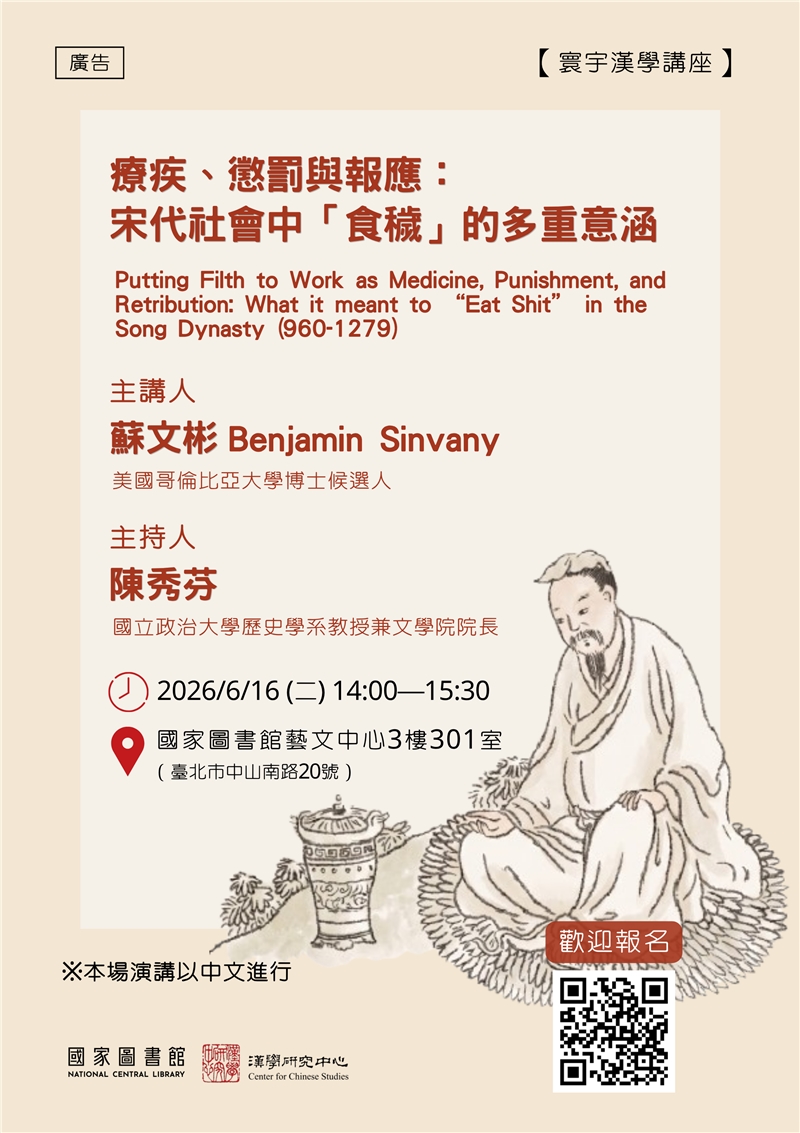
講者:蘇文彬(Benjamin Sinvany,美國哥倫比亞大學歷史系博士候選人)
講題:療疾、懲罰與報應:宋代社會中「食穢」的多重意涵(Putting Filth to Work as Medicine, Punishment, and Retribution: What it meant to “Eat Shit” in the Song Dynasty (960-1279))
主持人:陳秀芬(國立政治大學歷史學系教授兼文學院院長)
時間:2026年6月16日(週二)14:00-15:30
地點:國家圖書館藝文中心3樓301室(臺北市中山南路20號)
備註:本場演講以中文進行
※以上會議時間如有變動,本中心將依報名資料另行通知
演講摘要:
本場演講將探討宋代食用穢物的現象。這種行為在歷史文獻中常被稱為「食糞」或「食穢」,演講中將展示人們實際吞食糞便的相關記載。本研究引用了豐富的宋代文獻,包含筆記、志怪小說、醫方典籍,以及保存在類書中的歷史軼事。將這些史料交織起來,展現了一幅關於極端行為的多元圖景。在某些案例中,人們主動要求食用糞便;有些則是違背意願被迫吞食;還有些情況下,糞便被當作公認的解毒劑來服用。在宋代,人們食用人類排泄物的原因似乎至少可歸納為三種:受人脅迫、遭受報應(天譴)以及醫療用途。本次演講所呈現的案例,揭示了宋代社會中一種獨特的「潔淨觀」(logic of purity)。在這種觀念下,「食穢」 得以具備多重功能:它既是治病解毒的方法、一種具脅迫性的懲罰,也是遭受神明報應的具體表徵。
This talk is about the consumption of filth in the Song dynasty. Sometimes referred to as “eating shit” (食糞) or “eating filth” (食穢) this talk presents accounts of people literally eating feces. It uses a wide selection of Song sources including biji, records of the strange 志怪, medical prescription texts, as well as historical anecdotes preserved in leishu 類書. Taken together, these excerpts form a diverse mosaic of extreme behaviors. In some cases, people demand to eat feces, in others they are forced to consume it against their will, and in others it is administered as a known antidote to poisoning. There appear to be at least three different reasons people consumed human excrement in Song China: coercion, divine retribution, and medicine. The cases presented here reveal a logic of purity in the Song that allowed eating filth to function as a method for healing (an antidote to poison), a coercive punishment, and a symptom of divine retribution.
主講人簡介:
蘇文彬 (Benjamin AK Sinvany) 是哥倫比亞大學歷史系與東亞研究系的博士候選人,主要研究中國宋代 (960–1279) 的社會史。廣義而言,他的研究興趣涵蓋科技、知識傳遞,以及社會對「廢棄物」與「厭惡感」的建構。蘇文彬運用非傳統史料,如筆記小說與志怪小說,並結合技術手冊,來探討歷史上的社會變遷。在早期的研究中,蘇文彬提出:在十二和十三世紀的東亞,不同國家對硝石(potassium nitrate or saltpeter)和硫磺等關鍵資源的獲取,是推動火藥發明的主要驅動力。目前他的博士論文暫名為《化廢為用:宋代中國 (960-1279) 的糞便與知識》(Putting Waste to Work: Feces and Knowledge in Song (960-1279) China)。西元 900 至 1300 年間的中國經歷了史無前例的人口增長,新技術層出不窮,且社會高度商品化。透過記錄這段時期人們對人類糞便的使用與看法,為了解自然界實用知識的累積與傳遞,提供了一個獨特的視角。該計畫拓展了科學史中傳統的比較問題(例如:東亞是否與歐洲一樣,利用人畜糞尿來製造硝石?),將人類糞便歷史化,視其為一種既有用又令人厭惡、既強大又危險的物質。蘇文彬的論文計畫反映了他熱衷於運用社會史與文化史的研究方法,來解答中國研究與知識史交匯處的諸多問題。
在進入哥倫比亞大學之前,蘇文彬取得了埃默里大學(Emory University 亞特蘭大,2015 年)的學士學位,以及約翰·霍普金斯大學與南京大學(Johns Hopkins and Nanjing University 南京,2020 年)的碩士學位。他出生於美國俄亥俄州。在學術研究之外,他經常參加「接觸即興」(Contact Improvisation) 的工作坊與交流活動,也會參加滑水 (Waterski+Wakeboard) 比賽。
Benjamin is a History-East Asia Ph.D. candidate at Columbia University researching the social history of Song (960-1279) China. Broadly defined, his interests include technology, knowledge transmission, and social constructions of waste and disgust. Benjamin uses non-traditional sources like collections of ghost tales and other strange stories alongside technical manuals to investigate historical social change. In earlier work, Benjamin argues that access to key resources like nitrogen salts (saltpeter) and sulfur by multiple states in twelfth- and thirteenth-century East Asia was a primary driver of the invention of explosives (e.g., gunpowder). His current dissertation project, tentatively titled “Putting Waste to Work: Feces and Knowledge in Song (960-1279) China” broadens traditional comparative questions in the history of science (e.g., was saltpeter was made from human and animal excrement and urine in East Asia as it was in Europe?) to historicize human feces as something both useful and repugnant, powerful and dangerous. Documenting the uses and views of human feces in China from 900-1300 AD – a moment of unprecedented population growth, and abundance of new technologies, and a highly commodified society – provides a unique perspective on the accumulation and transmission of practical knowledge about the natural world. Benajmin’s dissertation project reflects his interest in mobilizing social and cultural historical methods to answer questions at the intersection of Chinese studies and histories of knowledge.
Before arriving at Columbia, Benjamin completed a BA at Emory University (Atlanta, '15) and an MA (International Studies) at Johns Hopkins University and Nanjing University (Nanjing, '20). He was born in Columbus, Ohio. He regularly joins Contact Improvisation workshops and jams. Occasionally, he competes in Waterski and Wakeboard competitions.
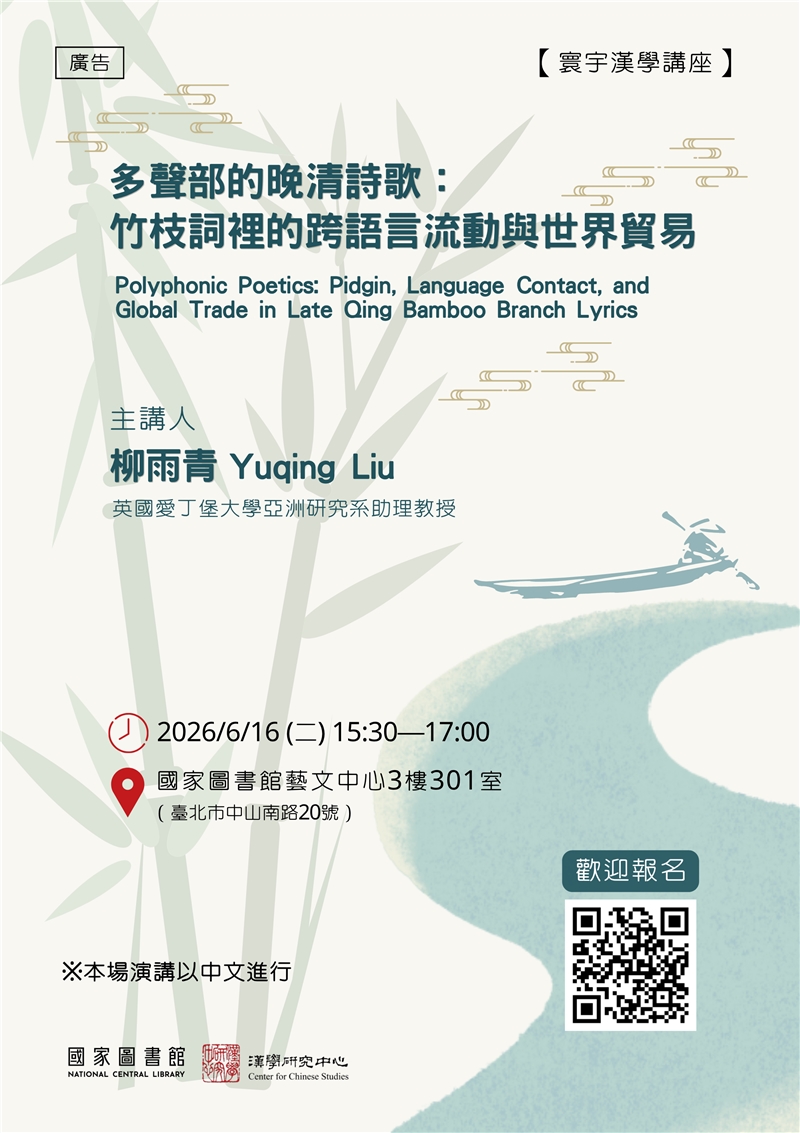
講者:柳雨青(Yuqing Liu,英國愛丁堡大學亞洲研究系助理教授)
講題:多聲部的晚清詩歌:竹枝詞裡的跨語言流動與世界貿易(Polyphonic Poetics: Pidgin, Language Contact, and Global Trade in Late Qing Bamboo Branch Lyrics)
主持人:待定
時間:2026年6月16日(週二)15:30-17:00
地點:國家圖書館藝文中心3樓301室(臺北市中山南路20號)
備註:本場演講以中文進行
※以上會議時間如有變動,本中心將依報名資料另行通知
演講摘要:
皮欽語最早於18世紀出現在中國珠江三角洲一帶,是一種由英語、粵語、葡萄牙語、馬來語、官話、閩南語等各種中外語言混合而成的通用語。19世紀中葉,第一次鴉片戰爭後,大批粵籍商人與勞工相繼赴滬謀生,此一語言遂隨之擴散至長江三角洲地區。我的報告將追溯這一貿易語在廣州與上海的聲音再現,並以兩組詩歌為核心:潘有度約於1812年前後所作《西洋雜詠》,及1873年刊載於《申報》之《別琴竹枝詞》。藉助漢字形、音、義的創新排列組合,詩中皮欽詞語與表達形式構建出多層次的意義結構,同時調動漢字之語義、視覺與語音諸維度。皮欽語的引入因此開啟了廣闊的詮釋向度,使得各種讀法彼此並立而不相排斥。此外,有別於傳統竹枝詞將異域語言收編馴化的書寫慣例,這些詩歌呈現相反的聲音想象:皮欽語的介入使本土的、慣常的、熟悉的景觀與聲景陌生化。這些詩歌將貿易中心的廣東與上海呈現為眾聲喧嘩、語言駁雜的聲景空間,使異域感不再附著於域外他鄉,而是深度滲透於詩人自身的語言實踐與日常生活肌理之中。
Pidgin English first appeared in China along the Pearl River Delta as a lingua franca composed of a mixture of English, Cantonese, Portuguese, Hindi, and Malay as early as the 18th century. This language spread to the Yangtze River delta in the mid 19th century when an increasing number of Cantonese merchants and workers traveled to Shanghai to seek opportunities after the First Opium War. This talk traces the sounds of pidgin in Canton and Shanghai, cantering on two suites of poems: “Miscellaneous Songs of Western Ocean” penned by Pan Youdu around 1812 and “Pidgin Bamboo Branch Lyrics” published in the Shen Bao in 1873. Through analysis, I explore how pidgin was incorporated into classical Chinese poetry and how it consequently reflected and shaped the literary soundscape of nineteenth century the trading centres in China. I argue that pidgin English created a polyphonic space wherein Sinographs and European words, literary language and local tongues, and classical images and contemporary anecdotes intertwine to generate diverse and contradictory meanings. Through an innovative collocation of the sinographic, literal, and phonetic features of Chinese characters, the pidgin words and expressions craft in these poems a multilayered structure of meanings based on the semantic, visual, and phonetic values of the sinographs. The usage of pidgin, therefore, opens up a wide array of interpretative possibilities, each providing a unique lens through which to read the work. Moreover, unlike traditional bamboo branch lyrics in which foreign words are transcribed and incorporated to domesticate strangeness and consolidate the imperial order, these pidgin poems have an inverse effect: their use of pidgin English alienates the native, the conventional, and the familiar landscape/soundscape. This poetry depicts Shanghai as a cacophonous soundscape awash with a mishmash of languages and voices, making foreignness appear not in a foreign land, but in one’s own poetic language and everyday life.
主講人簡介:
柳雨青現任英國愛丁堡大學亞洲研究系專任助理教授,目前為國家圖書館漢學研究中心獎助學人,台灣大學文學院訪問學者。研究領域為中國文學,主要關注文學中多語性、詞典編纂學、及中歐文化接觸史。其研究項目曾獲英國學術院、美國學術團體理事會、以及亞洲研究學會之學術研究資助。其正在撰寫專著系統考察皮欽語在中國和世界貿易與殖民網絡中的歷史源流,探討其自十八世紀至二十世紀初在中國與歐洲語言文學中的挪用與衍變。
Yuqing Liu is a lecturer in the Department of Asian Studies at the University of Edinburgh. She is currently a recipient of a research fellowship from the Centre for Chinese Studies at the National Central Library, and a Visiting Scholar in the College of Liberal Arts at National Taiwan University. She specialises in Chinese literature, with a focus on multilingual poetry, lexicography, and Sino-European contact. Her research has been awarded grants and fellowships from the British Academy, the American Council of Learned Societies, and the Association for Asian Studies. Her current book project examines the history of pidgin in China, as well as its appropriation and adaptation in Chinese and English literatures from the eighteenth to the early twentieth century.
網址: http://actio.ncl.edu.tw/activitydetails?uid=2&pid=933
主辦單位: 漢學研究中心
活動地點: 國家圖書館藝文中心3樓301室(臺北市中山南路20號)
聯絡人: ccsenews@ncl.edu.tw
-
 蘇文彬先生演講海報
 -
 0616柳雨青教授演講海報
- 資源查詢
- 公告資訊
- 關於本館
- 讀者服務
- 申辦服務
- 其他網頁連結
本館地址:100201臺北市中正區中山南路20號
總機:(02)2361-9132 傳真:(02)2311-0155
國家圖書館著作權聲明 Copyright © All rights reserved.
建議桌機最佳解析度為 1280*768或以上 更新日期:2026-05-24